Durian: The King of Fruits — You Either Love It or You Don't
The Fruit That Divides the World
Walk through almost any wet market in Singapore, Kuala Lumpur, or Bangkok and you'll smell it before you see it. That unmistakable aroma — somewhere between ripe cheese, onion, and overripe banana — hits you from half a street away. Welcome to Durian season. Love it or hate it, you cannot ignore it.
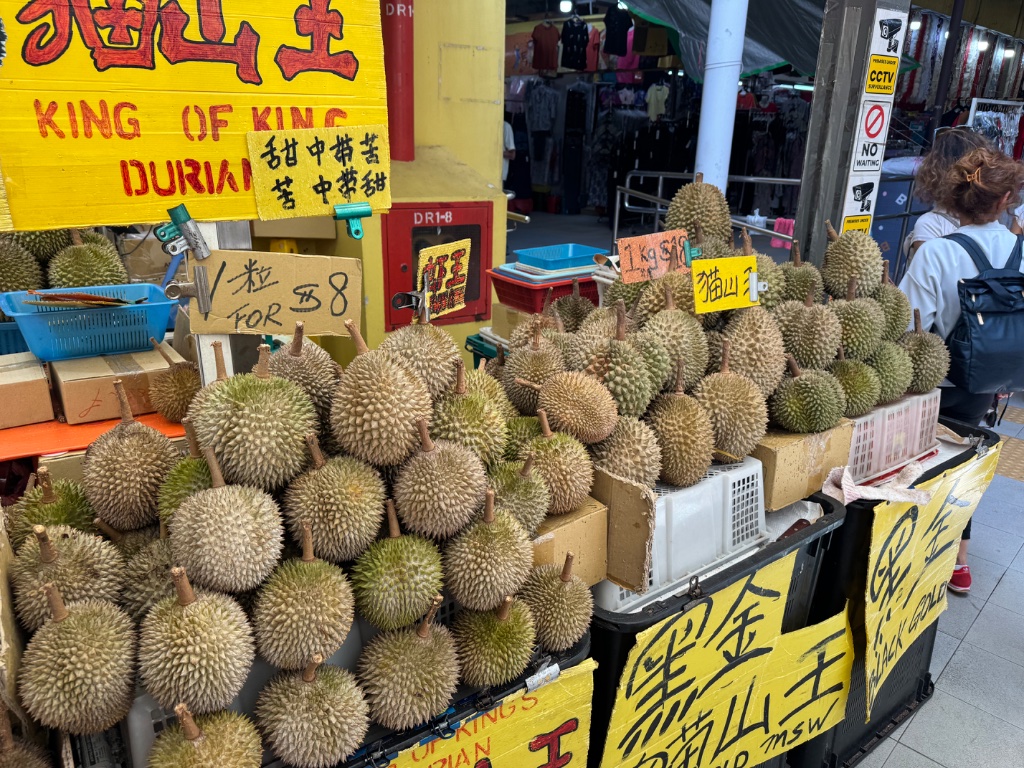
A classic durian stall — the sign says it all: "King of Kings".
A Brief History of the King
Durian (Durio zibethinus) is native to Southeast Asia and has been cultivated for thousands of years in Malaysia, Indonesia, and Thailand. Its name comes from the Malay word duri, meaning thorn — a nod to its formidable spiked shell that can weigh up to 3 kilograms and cause serious injury if it falls from height (which it does, regularly, in the tropical forests where it grows wild).
To locals, the durian isn't just a fruit — it's a cultural institution. Families gather for durian sessions the way Westerners might gather for a barbecue. Premium varieties like Musang King (Mao Shan Wang) or Black Gold fetch extraordinary prices, with a single fruit sometimes costing $50 SGD or more. And yet the queues stretch around the block.
The Case for the Lovers
If you can get past the smell — and that's a significant if — durian rewards you with something genuinely extraordinary. The flesh is creamy and custardy, rich with complex flavour notes that shift from sweet to bitter to almost savoury within a single mouthful. Anthony Bourdain, never one to shy away from a strong opinion, once said: "Its taste can only be described as... indescribable, something you will either love or despise... Your breath will smell as if you'd been French-kissing your dead grandmother."
That's a backhanded compliment if ever there was one — but it captures the paradox perfectly. The flavour is genuinely unlike anything else in the fruit world. There's a reason people travel specifically for durian season, booking trips to Malaysia in June and July just to eat the freshest Musang King straight from the husk, squatting on a plastic stool in the night market heat.
Nutritionally, it's a powerhouse too: high in fibre, vitamin C, potassium, and B vitamins. Traditional medicine across Southeast Asia has long attributed energising and even aphrodisiac properties to it. Whether that's true or wishful thinking is debatable — but it certainly gives you something to talk about.
The Case for the Haters
Let's be honest. The smell is a lot. Singapore's MRT, Changi Airport, and most hotels explicitly ban durian on their premises. There are signs. The smell lingers on your hands, your clothes, in the car, in the room. It has been compared to turpentine, raw sewage, and gym socks. One nineteenth-century British naturalist, Alfred Russel Wallace, described it as "a rich custard highly flavoured with almonds" — but that was before refrigerated shipping made the smell truly concentrated.
For many first-time travellers, durian is a rite of passage that ends badly. The texture alone — dense, slightly fibrous, almost gelatinous — is a challenge before the flavour even registers. And then there's the aftertaste, which can linger for hours. Locals will tell you to drink water from the empty husk to counteract it. Science suggests this actually works. Whether you're in any state to try it after your first taste is another question.
My Verdict
I've eaten durian in Singapore street markets, in a proper durian café in Penang, and once rather unwisely on a long-haul bus in Thailand. My conclusion: context is everything. Fresh, good-quality Musang King, eaten outside in the warm night air with a cold beer and good company? Genuinely wonderful. Pre-packaged durian paste from a supermarket? Entirely different — and not in a good way.
If you're a traveller and you haven't tried it, you should. Not because you'll necessarily love it, but because it's one of those experiences that tells you something about a place and its people. The fact that an entire culture has built festivals, family traditions, and a multi-million dollar industry around a fruit that smells like that — that's something worth understanding.
So next time you're in Southeast Asia and you see a "King of Kings Durian" stall with a queue out the door, don't walk past. Take a deep breath. Buy one. And find out which side of the divide you're on.
Are you a durian lover or a hater? Let us know in the comments — we'd love to hear your first durian story.
Comments (0)
No comments yet. Be the first!